

Introduction to IPL Match Prediction (2026 Complete Guide)
The Indian Premier League has evolved into one of the most competitive and widely followed cricket tournaments in the world. Every season brings intense rivalries, nail-biting finishes, and unpredictable outcomes that keep fans on the edge of their seats. In 2026, IPL match prediction has become more advanced than ever, combining traditional cricket knowledge with modern data analytics and real-time insights.
IPL match prediction is no longer just about guessing which team will win. It involves a deep understanding of multiple factors such as team composition, player performance, pitch conditions, weather impact, and match situations. With the rise of fantasy cricket platforms and data-driven tools, fans and analysts are now more engaged in predicting match outcomes than ever before.
One of the main reasons IPL prediction is so popular is the dynamic nature of T20 cricket. Unlike longer formats, T20 matches can change dramatically within a few overs. A single over from a bowler or a quick-fire innings from a batsman can completely shift the momentum of the game. This makes prediction both challenging and exciting at the same time. It also means that successful predictions require not just knowledge but also timing and adaptability.
In IPL 2026, teams like Mumbai Indians, Chennai Super Kings, and Royal Challengers Bangalore continue to dominate headlines with their strong squads and experienced players. However, newer teams and emerging talents are also making a significant impact, making the competition even more unpredictable. This balance between experience and youth adds another layer of complexity to match prediction.
Another important aspect of IPL match prediction is the role of technology. Advanced analytics tools now provide detailed statistics such as player strike rates, bowling economy, head-to-head records, and venue-based performance. These insights help analysts make more accurate predictions by identifying patterns and trends that are not visible to the naked eye. Artificial Intelligence (AI) and machine learning models are also being used to simulate match scenarios and forecast outcomes based on historical data.
Moreover, real-time updates have become crucial in modern IPL prediction. Information such as the toss result, playing XI, last-minute injuries, and weather conditions can significantly influence the outcome of a match. For example, winning the toss and choosing to bowl first can provide an advantage in night matches due to the dew factor. Ignoring such details can lead to inaccurate predictions, even if other factors are correctly analyzed.
The growing popularity of fantasy cricket platforms has also contributed to the rise of IPL match prediction. Users now create virtual teams based on real player performances, which requires careful analysis and strategic thinking. This has encouraged fans to study the game more deeply and understand the importance of data in decision-making. As a result, IPL prediction has become a skill that combines cricket knowledge with analytical thinking.
However, it is important to understand that no prediction is 100% guaranteed. Cricket is inherently unpredictable, and unexpected performances can always change the result. The goal of IPL match prediction is not perfection but improving accuracy over time by using the right strategies and information. Consistency in analysis and learning from past matches are key to becoming better at prediction.
In conclusion, IPL match prediction in 2026 is a blend of science and intuition. It requires a comprehensive approach that includes analyzing statistics, understanding match conditions, and staying updated with real-time information. Whether you are a beginner or an experienced analyst, mastering these elements can help you make smarter and more informed predictions. As the IPL continues to grow in popularity, the importance of accurate match prediction will only increase, making it an essential skill for every cricket enthusiast.
Key Factors That Influence IPL Match Prediction (2026 Deep Analysis)

Accurate IPL match prediction is not based on luck—it is the result of carefully analyzing multiple match-related factors. In the Indian Premier League, where every ball can change the game, understanding these key elements can significantly improve your prediction accuracy. Whether you are a beginner or an experienced analyst, mastering these factors is essential in 2026.
🏏 1. Team Form and Recent Performance
One of the most crucial aspects of IPL match prediction is evaluating the current form of teams. Even strong teams like Mumbai Indians or Chennai Super Kings can struggle if they are out of form.
What to analyze:
- Last 3–5 match results
- Net Run Rate (NRR)
- Batting and bowling consistency
- Winning or losing streaks
👉 Teams with strong momentum tend to perform better under pressure. However, overconfidence or fatigue can sometimes impact performance, so balance is key.
🌍 2. Pitch Report and Ground Conditions
Pitch conditions play a decisive role in determining match outcomes. Every stadium in India has a unique surface behavior.
Common pitch types:
- Flat pitches: Favor batsmen (high scoring matches)
- Dry pitches: Help spinners dominate
- Green pitches: Assist fast bowlers
👉 For example, Chennai grounds usually support spin bowling, while Mumbai stadiums often favor batting.
Ignoring pitch reports is one of the biggest mistakes beginners make in IPL prediction.
🎯 3. Toss Factor and Match Decision
The toss plays a critical role in IPL matches, especially in night games.
Why toss matters:
- Dew factor makes chasing easier
- Teams prefer bowling first in most matches
- Conditions change between innings
👉 Statistics show that teams winning the toss often gain a strategic advantage, particularly in high-pressure matches.
🔥 4. Player Form and Impact Players
Individual brilliance can completely change the outcome of a match. Players like Virat Kohli or Rohit Sharma are known for delivering match-winning performances.
Key player metrics:
- Batting strike rate
- Bowling economy
- Recent match performances
- Fitness and injury status
👉 Always check the playing XI before making final predictions.
📊 5. Head-to-Head Records
Historical data between teams can provide valuable insights.
Why it matters:
- Some teams dominate specific opponents
- Psychological advantage plays a role
- Helps identify match patterns
👉 Example: Certain teams consistently outperform others due to strategy or matchups.
🌦 6. Weather Conditions and Dew Factor
Weather conditions are often underestimated but can have a huge impact on match results.
Key factors:
- Dew (helps chasing team)
- Rain interruptions (Duckworth-Lewis method)
- Humidity affecting swing bowling
👉 Night matches in IPL usually favor chasing teams due to dew.
⚖️ 7. Team Combination and Balance
A balanced team has a higher chance of winning.
Ideal team structure:
- Strong top-order batting
- Reliable middle order
- Quality all-rounders
- Effective bowling attack
👉 Teams with depth in both batting and bowling perform more consistently.
Advanced IPL Match Prediction Strategies (2026 Expert Guide)
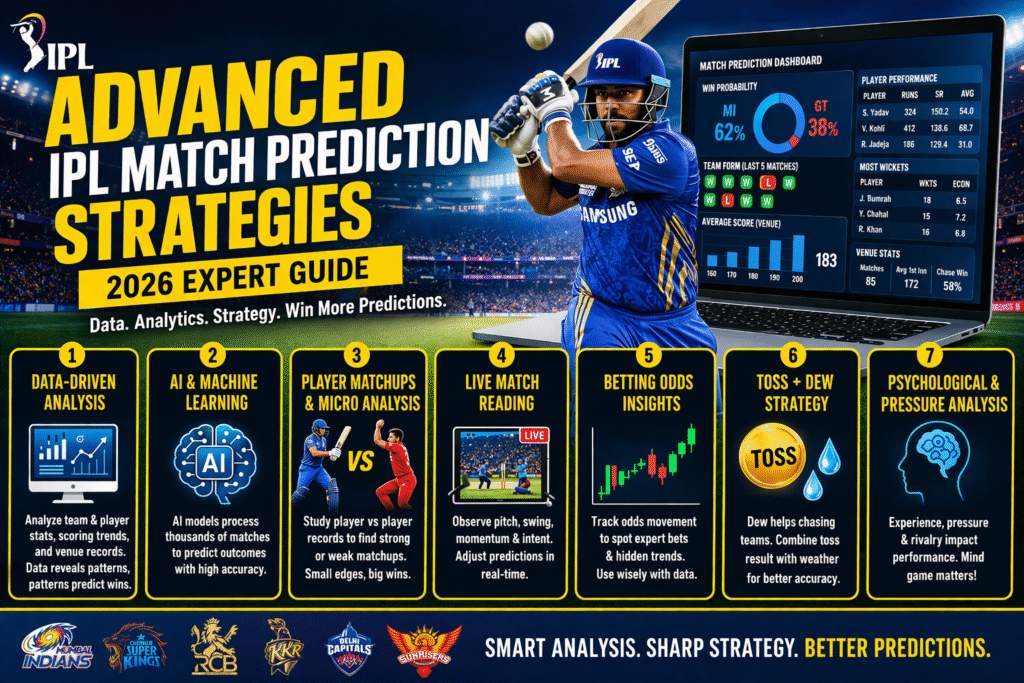
In the modern era of the Indian Premier League, match prediction has gone beyond basic analysis. With the availability of advanced statistics, AI tools, and real-time match data, predicting IPL matches in 2026 requires a more strategic and analytical approach. This section will guide you through advanced IPL match prediction strategies used by experts to improve accuracy and consistency.
📊 1. Data-Driven Analysis Approach
One of the most powerful strategies in IPL match prediction is using data analytics. Instead of relying on assumptions, expert predictors analyze detailed statistics to identify patterns.
Key data points to analyze:
- Powerplay performance (first 6 overs)
- Middle overs stability
- Death overs efficiency
- Team scoring trends at specific venues
👉 Example: Teams like Chennai Super Kings often perform strongly in middle overs due to experienced players.
Using historical and recent data helps in identifying hidden trends that significantly improve prediction accuracy.
🤖 2. AI and Machine Learning Predictions
In 2026, Artificial Intelligence has become a game-changer in IPL predictions. AI models analyze thousands of past matches to predict outcomes based on probability.
How AI helps:
- Simulates match scenarios
- Predicts win probability in real-time
- Analyzes player vs player matchups
👉 Many advanced platforms now use AI to provide live prediction percentages during matches.
However, AI should be used as a support tool, not the only decision-maker.
🎯 3. Player Matchups and Micro Analysis
Another advanced technique is analyzing player vs player matchups.
Examples:
- Certain bowlers consistently dismiss specific batsmen
- Some batsmen dominate particular bowling styles
👉 Example: A top batsman may struggle against left-arm spin but dominate pace bowling.
This micro-level analysis gives a strong edge in close matches.
📈 4. Live Match Reading Strategy
Professional predictors don’t just analyze before the match—they adjust predictions during the match.
What to observe live:
- Pitch behavior in first innings
- Ball swing or turn
- Player intent and aggression
👉 If the pitch is slower than expected, predictions should be adjusted accordingly.
Live match reading is one of the most underrated but powerful strategies.
⚡ 5. Betting Market and Odds Movement (Insight Strategy)
While not always discussed openly, many experts observe odds movement trends.
Why it matters:
- Reflects public sentiment
- Shows expert betting patterns
- Indicates possible match trends
👉 Sudden odds shifts may signal important changes like player injury or pitch behavior.
⚠️ Always use this insight carefully and combine it with actual analysis.
🌙 6. Toss + Dew Combination Strategy
Combining toss result with dew factor is a highly effective strategy.
Strategy:
- If heavy dew expected → Choose chasing team
- If dry pitch → Batting first may be better
👉 This combination significantly increases prediction success rate.
🧠 7. Psychological and Pressure Analysis
Cricket is not just physical—it’s mental.
Factors to consider:
- Knockout pressure
- Rivalry matches
- Captaincy decisions
👉 Experienced teams like Mumbai Indians handle pressure better in crucial matches.
❓ IPL Match Prediction FAQ (2026 Complete Guide)
1. What is IPL Match Prediction?
IPL match prediction is the process of analyzing different match factors such as team performance, player form, pitch conditions, and match situations to forecast the outcome of a match in the Indian Premier League. It is not based on guesswork but on data-driven insights and cricket knowledge. In 2026, prediction has become more advanced with the use of analytics tools and AI-based models.
2. How accurate are IPL match predictions?
IPL match predictions are never 100% accurate because cricket is an unpredictable sport. However, using proper strategies like pitch analysis, toss impact, and player statistics can significantly improve accuracy. Expert predictions can achieve high success rates when multiple factors are analyzed correctly.
3. What factors are most important in IPL prediction?
The most important factors include:
- Team form and momentum
- Pitch and weather conditions
- Toss result
- Player performance
- Head-to-head records
Ignoring any of these can reduce prediction accuracy. A balanced analysis of all factors gives better results.
4. Why is toss important in IPL matches?
The toss plays a crucial role because teams often prefer chasing, especially in night matches where dew affects the game. Winning the toss can provide a strategic advantage, which is why it is essential to wait for the toss result before making final predictions.
5. How does pitch report affect match prediction?
Pitch conditions directly influence match outcomes. A batting-friendly pitch results in high-scoring games, while spin-friendly pitches support bowlers. Understanding pitch behavior helps in predicting which team has an advantage.
6. Can AI improve IPL match predictions?
Yes, Artificial Intelligence and machine learning models can analyze large datasets, identify patterns, and predict match outcomes with better accuracy. However, AI should be used along with human analysis for the best results.
7. What is the role of player form in IPL prediction?
Player form is one of the most critical factors. In-form players can change the game single-handedly. Analyzing recent performances, strike rates, and consistency helps in making better predictions.
8. Are head-to-head records useful?
Yes, head-to-head records provide insights into how teams perform against each other. Some teams have a psychological advantage over others, which can influence match results.
9. How does weather impact IPL matches?
Weather conditions such as dew, humidity, and rain can affect gameplay. Dew makes it easier for chasing teams, while rain can reduce overs and change match dynamics using methods like DLS.
10. Is IPL prediction useful for fantasy cricket?
Absolutely. IPL match prediction helps fantasy cricket players select better teams by analyzing player form, pitch conditions, and match scenarios. It increases the chances of scoring higher points.
Conclusion: Mastering IPL Match Prediction in 2026
The journey of understanding IPL Match Prediction in 2026 clearly shows that success in prediction is no longer based on luck or random guessing. The Indian Premier League has evolved into a highly competitive and data-driven tournament where every detail matters. From team strategies to player performance and match conditions, each factor plays a critical role in determining the outcome of a game.
Over the course of this guide, we explored the most important aspects of IPL match prediction, starting from basic concepts to advanced strategies. One key takeaway is that no single factor can guarantee accurate IPL Match Prediction. Instead, the best results come from combining multiple insights such as team form, pitch conditions, toss decisions, and player statistics.
In modern IPL prediction, understanding team dynamics is essential. Teams like Mumbai Indians and Chennai Super Kings have shown over the years how consistency, leadership, and experience can influence match outcomes. However, IPL 2026 has also highlighted the rise of new talents and emerging teams, making predictions even more exciting and challenging.
Another important aspect is the role of technology in cricket prediction. With the help of advanced data analytics, artificial intelligence, and real-time match tracking, prediction methods have become more accurate and reliable. These tools allow users to analyze player performance, compare team strengths, and identify patterns that were previously difficult to detect. However, relying solely on technology is not enough. Human understanding of the game, intuition, and experience are equally important.
The toss factor continues to be one of the most influential elements in IPL matches. Especially in night games, where dew affects bowling conditions, teams often prefer chasing targets. This makes it crucial for predictors to wait for the toss before making final decisions. Ignoring such real-time updates can lead to inaccurate predictions, even if other factors are analyzed correctly.
Player performance is another game-changing element. Star players like Virat Kohli or Rohit Sharma have the ability to single-handedly turn the match in their team’s favor. At the same time, lesser-known players can also emerge as match-winners, which adds an unpredictable dimension to IPL games. This is why keeping track of current form, injuries, and playing XI is essential.
Weather and pitch conditions further add complexity to IPL match prediction. A dry pitch may favor spin bowlers, while a flat pitch can lead to high-scoring matches. Similarly, weather conditions like humidity and rain can influence match flow and strategy. Smart predictors always consider these external factors before making decisions.
Another critical insight is the importance of avoiding common mistakes. Many beginners rely too much on team popularity or emotional bias, which often leads to poor predictions. Successful prediction requires a logical and analytical approach, free from personal preferences. It is about making decisions based on facts, not emotions.
As IPL continues to grow in popularity, match prediction has also become a valuable skill, especially for fantasy cricket players and sports analysts. By applying the right strategies and continuously learning from past matches, anyone can improve their prediction accuracy over time. Consistency, patience, and regular analysis are the keys to long-term success.
In conclusion, IPL match prediction in 2026 is a combination of data, strategy, and cricket intelligence. It is a skill that can be developed with practice and the right approach. While it is impossible to predict every match correctly, using the techniques discussed in this guide will significantly increase your chances of success.